Only 9% of websites (20 of 223) are AI-Ready. The median site scores 65/100 — passing traditional SEO basics like robots tags and Open Graph, but failing almost every AI-specific signal: 98.7% have no AI crawler permissions, 73.5% have no AEO-friendly structured data, and 87% write at a reading level too complex for AI extraction.
AI-powered search engines — ChatGPT, Perplexity, Gemini, Claude — are rewriting how people find and choose businesses. Yet the vast majority of websites are not ready for them.
We analysed 223 unique websites across 26 industries using CiteTrust's AI-readiness scoring framework, which evaluates ten signals that determine whether AI systems can find, read, and cite a website. The results paint a stark picture: sites have spent years optimising for Google's traditional crawlers and largely succeeded, but the signals AI systems actually use to select and cite sources are being ignored almost universally.
What the Score Means
| Score | Rating | What it means |
|---|---|---|
| 80–100 | AI-Ready | AI search engines can find, read, and cite this site reliably. Structured data, AI crawler permissions, and answer-friendly content are all in place. |
| 60–79 | Getting There | Traditional SEO basics are covered, but AI-specific signals are missing. These sites may appear in AI answers inconsistently or not at all. |
| 40–59 | Behind | Significant gaps across multiple categories. AI systems will struggle to extract useful information from these sites. |
| 0–39 | Critical | Fundamental issues with metadata, structure, and AI accessibility. These sites are essentially invisible to AI search. |
The AI Readiness Gap
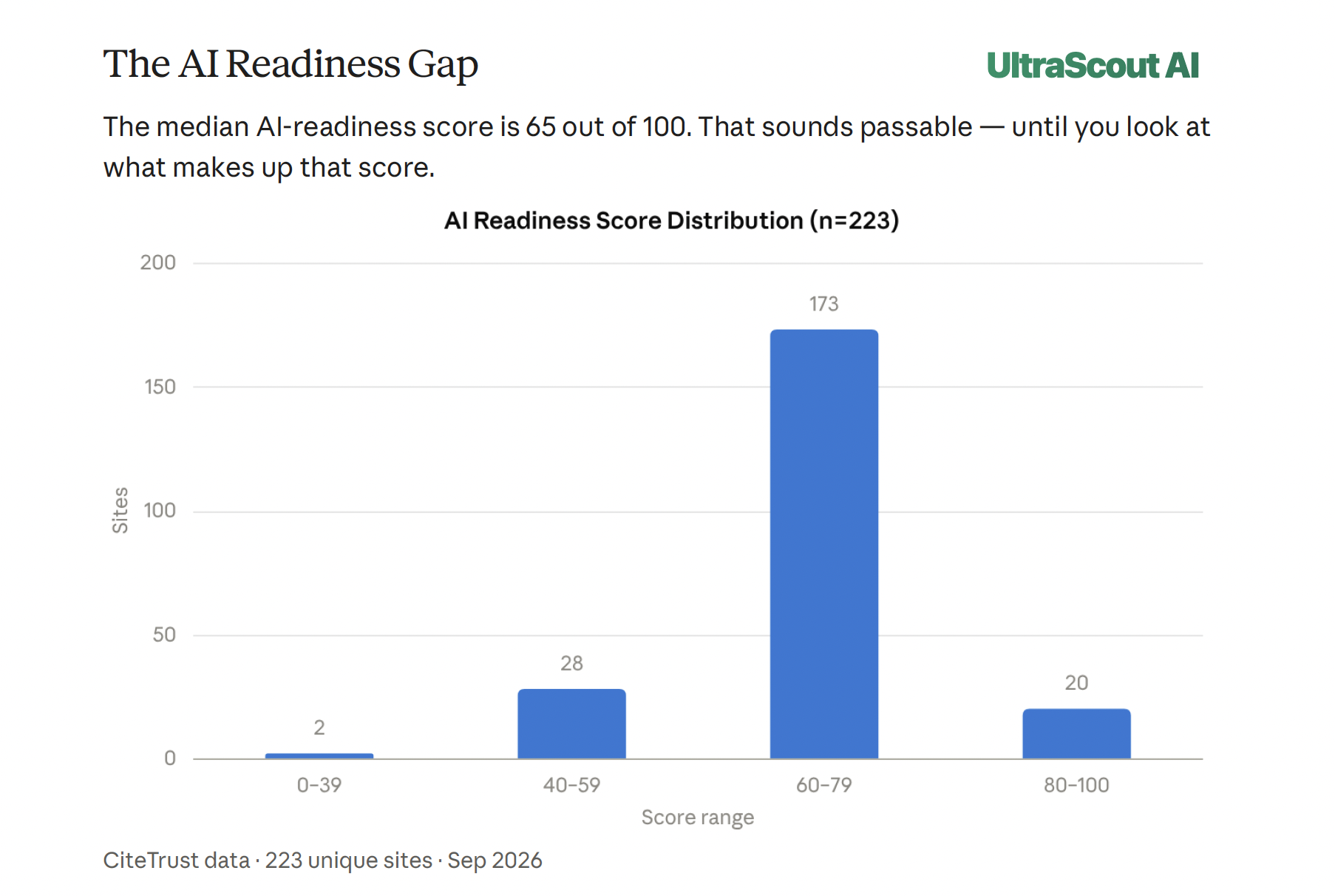
The median AI-readiness score is 65 out of 100. That sounds passable — until you look at what makes up that score. 173 of 223 sites (77.6%) cluster in the 60–79 band: they pass the basics but fail the checks AI systems actually use to decide whether to cite a source. Only 20 of 223 sites (9%) reach the 80+ threshold where all five scoring categories are in healthy shape.
The gap becomes clearer when you compare category averages. Technical SEO averages 93 out of 100 across the sample. AI Optimisation averages just 39. That 54-point spread is the AI readiness gap: the distance between where most sites are investing and where AI search engines are actually looking.
| Category | Average Score | Interpretation |
|---|---|---|
| Technical SEO | 93.4 | Solved — nearly every site passes |
| Social Media (Open Graph) | 76.1 | Mostly covered |
| Basic Meta Tags | 70.1 | Adequate, with gaps in description length |
| AEO & Voice Search | 48.7 | Weak — poor readability and no question-based headings |
| AI Optimisation | 39.2 | Critical — almost no sites address AI crawlers directly |
Where the Score Gap Comes From
Using our scoring framework, these checks contribute the largest share of the overall score gap. Avg Score is the mean check score across all 223 sites; Share of Overall Gap is how much each check contributes to the total distance between current scores and 100.
| Check | Avg Score | Share of Overall Gap |
|---|---|---|
| AI crawler permissions | 23.7 | 20.5% |
| Content readability | 35.3 | 17.4% |
| Rich snippet schema | 44.8 | 14.8% |
| Answer-first summary | 53.4 | 12.5% |
| Citation signals | 61.2 | 10.4% |
| Meta description | 70.1 | 8.0% |
| llms.txt | 70.1 | 8.0% |
| Open Graph tags | 76.1 | 6.4% |
| Robots meta tag | 93.4 | 1.8% |
The top three checks alone — AI crawler permissions, content readability, and rich snippet schema — account for more than half of the total gap.
The 5 Biggest Failures
Ten checks make up the CiteTrust score. Five of them have pass rates below 31% — meaning fewer than one in three sites get them right. These are the checks that separate AI-ready sites from the rest.
1. AI Crawler Permissions 1.3% pass
Just three of 223 sites explicitly allow-list AI crawlers. The functional mechanism here is robots.txt — a User-agent: GPTBot, User-agent: ClaudeBot, or User-agent: Google-Extended entry is what actually grants or denies crawl access. (Declarative meta tags such as <meta name="chatgpt:preferred"> are not a recognised standard any crawler reads — they carry no functional weight, unlike the real googlebot and bingbot meta tags, which are.) Without a robots.txt allow-list, AI systems must guess whether they're permitted — and many default to caution, skipping the site entirely. This check accounts for 20.5% of the overall score gap.
2. Content Readability 13.0% pass
AI systems favour content written at a grade 8 reading level or below — clear, direct sentences that can be extracted as answers. 87% of sites score above grade 10, with the highest observed reaching grade 19.8. Complex sentences, passive voice, and jargon-heavy copy make it harder for AI to pull a clean, citable answer. This check accounts for 17.4% of the overall score gap.
3. Answer-First Summaries 24.2% pass
Question-based headings ("What is...?", "How does...?") signal to AI systems that the content below directly answers a user query. Only 54 sites use this pattern. The rest bury answers in long paragraphs under vague headings, making it harder for AI to match content to questions. This check accounts for 12.5% of the overall score gap.
4. Rich Snippet Schema 26.5% pass
FAQPage, HowTo, and other AEO-friendly structured data give AI systems a machine-readable map of your content. 73.5% of sites have no such schema. Without it, AI has to parse raw HTML and guess what each section means. This check accounts for 14.8% of the overall score gap.
5. Citation Signals 30.9% pass
Timestamps, author names, source references, and other markers that help AI systems decide whether to cite content as authoritative. 69.1% of sites lack these signals, making their content less likely to be selected when an AI assembles an answer. This check accounts for 10.4% of the overall score gap.
Industry Scorecard
AI readiness varies by industry, but the range is narrow — 10 points separate the top from the bottom. No industry has cracked the code.
Construction & Trades and Real Estate share the top spot at 70.6 (n=5 each), driven by higher-than-average llms.txt adoption and better meta descriptions. At the other end, Food & Beverage (60.2, n=4) and Home Services (60.3, n=3) lag, with weaker structured data and lower readability scores.
Technology — the largest segment at 55 sites — sits in the middle at 66.8. Despite being the industry most likely to understand AI systems, tech sites are no better prepared than average. The top 9% of all sites skews heavily toward Technology (11 of 20), but the median tech site is unremarkable.
The tight range tells a story: AI readiness is not an industry problem. It is a universal blind spot. Every sector has built for traditional search and left AI optimisation as an afterthought.
AI Readiness Is a Global Gap
The sample includes sites in 11 non-English languages: Turkish, Arabic, Spanish, Swedish, Norwegian, Polish, Czech, Korean, Japanese, Hebrew, and Persian. Non-English sites (63 of 223) averaged 66.3 — close to the English-language average of 65.8. AI readiness is not an English-language problem and not a local one. The same pattern of strong traditional SEO and weak AI optimisation holds across languages and regions.
What the Top 9% Get Right
The 20 sites that score 80 or above share a clear pattern. They do not just pass the easy checks — they dominate the ones most sites fail.
| Check | Top 9% Pass Rate | Overall Pass Rate | Gap |
|---|---|---|---|
| Robots meta tag | 100% | 99.6% | +0.4 pp |
| Open Graph tags | 95% | 70.4% | +24.6 pp |
| Rich snippet schema | 95% | 26.5% | +68.5 pp |
| Meta description | 90% | 50.7% | +39.3 pp |
| llms.txt | 90% | 59.6% | +30.4 pp |
| Citation signals | 55% | 30.9% | +24.1 pp |
| Answer-first summary | 35% | 24.2% | +10.8 pp |
| Content readability | 15% | 13.0% | +2.0 pp |
| AI crawler permissions | 10% | 1.3% | +8.7 pp |
The biggest differentiator is rich snippet schema: 95% of top sites have AEO-friendly structured data, versus just 26.5% overall — a 68.5 percentage-point gap. This is the single strongest predictor of a high score.
The second factor is completeness of meta tags: top sites have optimised descriptions (90%) and full Open Graph (95%), ensuring AI systems get clean, structured information at every entry point.
Notably, even the top 9% struggle with two checks. Content readability passes at just 15%, and AI crawler permissions at 10%. These are emerging signals that even the best-prepared sites have not yet adopted. The opportunity is wide open: the first movers on these two signals will have a measurable edge.
11 of the 20 top-scoring sites come from the Technology sector. The remaining 9 span seven industries, showing that AI readiness is achievable for any sector — it just requires deliberate effort.
3 Quick Wins to Improve Your AI Readiness This Week
These three actions address the lowest-scoring checks in our data and can be implemented without a redesign or a developer sprint.
1Add an llms.txt file (40.4% of sites are missing one)
Create a plain text file at yoursite.com/llms.txt that tells AI crawlers what your site is, which pages matter most, and how to use your content. This is the AI equivalent of robots.txt — a direct line of communication with LLMs. 59.6% of sites already have one; joining them is a 10-minute task.
2Allow-list AI crawlers in robots.txt (98.7% of sites haven't)
Add explicit User-agent entries to your robots.txt for GPTBot, ClaudeBot, Google-Extended, PerplexityBot, and Amazonbot — this is the actual mechanism that grants or denies AI crawl access, the same way User-agent: Googlebot works for classic search. Without an explicit allow-list, AI systems default to their own caution policies, which often means skipping your content entirely. This is the single most neglected signal in our dataset.
3Add FAQ schema to your top pages (73.5% of sites have no AEO schema)
Wrap your most-asked questions in FAQPage structured data. This gives AI systems a machine-readable Q&A format they can extract directly. Top-tier sites are far more likely to carry it: 32% of sites with schema score 80+, versus under 1% of those without. Correlation is not causation — but schema is the strongest single differentiator in our dataset. Start with your homepage and your three highest-traffic pages.
From Behind to AI-Ready: One Site's Journey
An 8-Scan Journey, June–September 2026
One B2B SaaS site in our dataset (not ultrascout.ai) was scanned eight times between June and September 2026. Its first scan scored 75 — squarely in the "Getting There" band. Over the following weeks, it added structured data, optimised its meta descriptions, and improved its content readability.
A 13-point improvement, achieved without a redesign — just systematic attention to the checks that matter.
Frequently Asked Questions
What percentage of websites are ready for AI search in 2026?
Only 9% of websites (20 of 223 analysed) reach the AI-Ready band (score of 80+) in CiteTrust's AI-readiness scoring framework. The median score across all sites is 65 out of 100 — sites pass traditional SEO basics but fail the checks that matter most for AI visibility.
What is the biggest AI readiness failure for websites?
AI crawler permissions have the lowest pass rate at just 1.3% — only 3 of 223 sites explicitly allow-list AI crawlers such as GPTBot, ClaudeBot, and Google-Extended in their robots.txt file. Without this, the crawler cannot confirm it's permitted to fetch content, and many default to skipping the site. This single check accounts for 20.5% of the overall AI-readiness score gap.
Does industry affect AI readiness scores?
Barely. Industry average scores cluster within a 10-point range (60.2 to 70.6 across 24 industries with 2+ sites), showing AI readiness is a universal blind spot rather than an industry-specific problem. Even Technology, the largest and most AI-literate segment in the sample, scores only 66.8 on average — unremarkable despite contributing 11 of the 20 top-scoring sites.
What are quick wins to improve AI readiness?
Three changes address the lowest-scoring checks without a redesign: add an llms.txt file (40.4% of sites are missing one), allow-list GPTBot, ClaudeBot, and Google-Extended in robots.txt (98.7% of sites are missing these entries), and add FAQPage schema to top pages (73.5% of sites have no AEO-friendly structured data).
What separates the top 9% of AI-ready sites from the rest?
Rich snippet schema is the single strongest predictor: 95% of top-scoring sites have AEO-friendly structured data (FAQPage, HowTo) versus just 26.5% overall — a 68.5 percentage-point gap. Complete meta tags (90% optimised descriptions, 95% full Open Graph) are the second differentiator. Even top sites lag on content readability (15% pass) and AI crawler permissions (10% pass), leaving room for a first-mover advantage.
Methodology
Tool: CiteTrust free AI-readiness checker, part of the UltraScout AI platform.
Sample: 291 scans of 223 unique websites between 25 June and 19 September 2026. Where a domain was scanned more than once, the most recent scan was kept. Sites are self-selected — users found the tool through organic search, social media, and referrals.
Scoring: Each site is evaluated on 10 checks across 5 categories: Technical SEO, Basic Meta Tags, Social Media, AEO & Voice Search, and AI Optimisation. Each check is scored 0–100 and combined into an overall 0–100 readiness score using our internal weighting framework. The checks assess signals that influence whether AI search engines can find, parse, and cite a website.
Industries: Sites were classified into 26 industries by the research team based on their title, meta description, and visible page content. This was a manual classification step. 24 industries with two or more sites are shown in the industry scorecard; two industries with a single site each (Architecture & Design, Gaming) are included in the overall figures but not charted separately.